
ERGODYNAMIC crutches
User notice — unofficial, but serious (more or less)
“Informal document — does not replace official medical instructions, the advice of your healthcare professional, or your common sense. Tempting as that may be sometimes.”
Some useful things do not always appear in official instructions.
Here is a more human version, inspired by real patient experience.
Indications
Temporary assistance device intended to:
- Support a lower limb during recovery
- Keep your wrists and shoulders from staging a rebellion
- Preserve your “ambulatory dignity”
- Prevent your upper joints from opening a case against you
Recommended dosage
- Never use more than two crutches at the same time. Two are enough. Three would be ambitious. Four, conceptual.
- After recent surgery: use them as soon as you get up, even if your bed begs you to stay.
- As things improve: move from 2 → 1 → 0 according to medical advice, in that order.
- In case of heroic momentum: consult your physiotherapist before any improvised marathon attempt.
Expected effects
- Possible reduction in discomfort linked to repeated weight-bearing.
- More attention available for your mobility.
- Fewer internal negotiations with your shoulders.
- Less energy wasted anywhere other than your rehabilitation.
- Less desire to throw your crutches out of the window.
Addiction rate
Studies show an extremely low rate of pharmacological dependence.
Unlike certain famous painkillers, these crutches do not modify your opioid receptors.
However… if you own three of them, you probably have a coordination issue.
Or early-stage attachment. Consult the people around you.
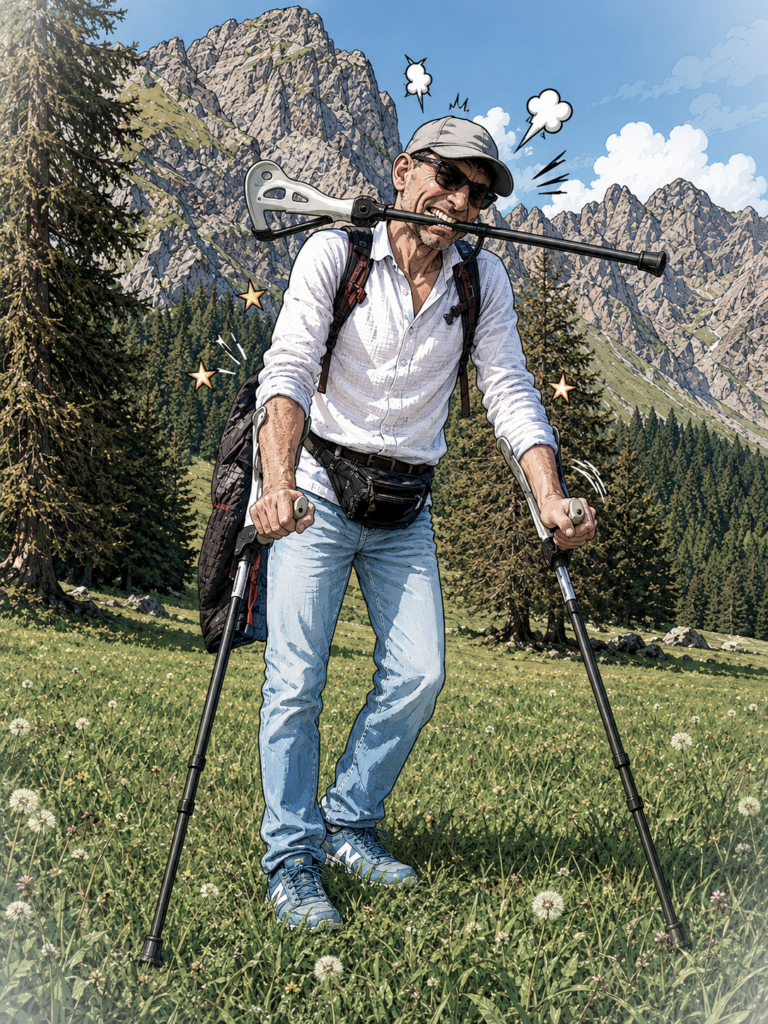
Potential side effects — prolonged or unsuitable use
• Temporary technical dependence
Increased sense of security.
You may develop a moderate emotional attachment.
This is normal. They support you at a vulnerable moment.
Like a friend.
Made of aluminium.
(A.C.: Aluminium Companions. Not exactly an act of charity. Well… almost.) Good news: this confidence can gradually be transferred back to your own abilities.
• Muscle adaptation — possible muscle wasting
Quadriceps are not resentful, but they do not like being ignored for too long.
Respect your rehabilitation plan or they may go on holiday without notice.
• Musculoskeletal complaints
Shoulders, wrists or back may protest if you use them like human jackhammers.
Even with the best crutches in the world:
if you bend like Quasimodo,
biomechanics will eventually make itself heard.
Posture is your ally.
• Gait imbalance
If your crutches become an extension of your personality – “My crutches and I are one” – it is time to discuss it with your physio.
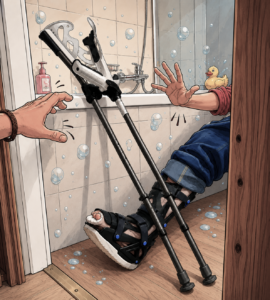
• Unintentional impact
May occur during:
- over-ambitious U-turns
- poorly assessed doorways
- instinctive anti-borrowing defence
- optimistic coordination
A distinctive “CLONG” may be heard.
→ In case of impact — wall, shin or distracted relative – apply ice immediately to the affected area.
Check your ego afterwards.
Unexpected side effects — rarer, but rather pleasant
• Temporary technical confidence
May occur during the first few outings.
Brighter expression. More stable posture.
→ In case of persistent smiling, apply ice to the cheeks to maintain a serious reputation.
• Increase in ambulatory dignity
Not reimbursed by insurance.
• Intolérance progressive aux appuis agressifs
Certaines personnes développent un nouveau standard de confort.
Les retours en arrière deviennent alors psychologiquement difficiles.
Severe borrowing risk
People around you may suddenly:
- “have had knee pain for ages”
- want to “try them for just five minutes”
- mysteriously disappear with your equipment
→ Reminder: personal device.
→ Recovery is not a community asset.
→ The short and complete answer remains: NO.
Replaced dependencies
Some people report that instead of developing:
- a fear of letting go of the crutches
- protective tension
- a defensive posture
They develop:
- gradual confidence
- a smoother gait
- better tolerance of effort
The final objective remains the transition back to autonomy. Always.
Contraindications
- Use as unsupervised contemporary dance props.
- Medieval duels.
- Displays of strength in unsuitable settings.
Philosophical warning
Your injury is temporary – at least, we hope so.
Your upper-body joint capital, however, is precious.
These crutches do not replace your rehabilitation. They support it.
Ethical clause
This document is not here to dramatise pain or create an artificial need.
If you can walk comfortably without them, we will be sincerely happy for you.
If you would like a little more gentleness for a few weeks, you are allowed.
“We do not go further.
We go better.”