
What changes
Once you have to walk with crutches,
some details matter straight away.
Real comfort is not decided on a technical sheet. You feel it in your hands, wrists, shoulders — and in everyday fatigue.
Here is what changes in practical terms with a more thoughtful design.
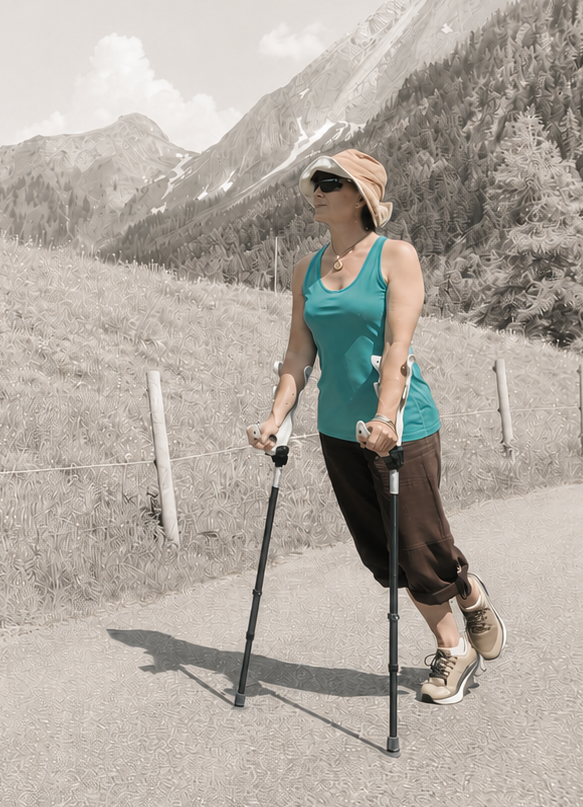
THE PROBLEM
What many crutches leave for the body to deal with
With every support, the upper body takes the load.
Over a few days, that may remain manageable.
Over several weeks, it changes everything: tired hands, pressure on the wrists, more strain on the shoulders, and support points that become less and less tolerable.
Standard crutches provide support.
They were not designed to distribute pressure better or to truly accompany movement.
KEY DIFFERENCES
What really changes when you have to rely on crutches
Three design choices that matter when crutches are no longer just a temporary backup.


LIVED EXPERIENCE
What people often feel
Over time, the same feedback tends to come back.
Not because it is miraculous. Because certain details genuinely end up mattering.
Support often feels more tolerable from the first days
Less harshness felt in the hands at the end of the day
Walking often feels smoother over time

Less weariness when crutches truly become part of daily life
HONESTY
What this does not promise
No miracle. Not the same experience for everyone.
A better-designed crutch does not remove the fatigue of recovery.
It does not replace medical follow-up. It is not necessarily suitable for every situation.
But when use lasts, a more thoughtful design can make a real difference in comfort — and that is often already a lot.
Which model should you look at first?
I eventually made my choice. In the end, the simplest way is to see which one truly matches your use.