La béquille : des millénaires d’usage, très peu de réinvention
On pourrait croire qu’un outil aussi fondamental aurait été repensé cent fois. En réalité, la béquille a traversé les siècles avec très peu de vraie réinvention. C’est précisément ce qui rend ses évolutions modernes si intéressantes.
Il y a 4 000 à 5 000 ans : avant l’objet médical spécialisé, il y a le bâton
On n’a pas une date magique où “la béquille” serait née un mardi matin.
Ce qu’on a, c’est une évidence anthropologique : dès qu’un humain ne pouvait plus marcher normalement, il utilisait un bâton, un appui, une branche, un support.
Autrement dit, la préhistoire de la béquille, c’est probablement le bâton de marche détourné. On peut raisonnablement dire que la fonction précède de très loin l’objet spécialisé. L’ennui, c’est que le bois laisse peu de traces, donc l’archéologie est avare.
L’idée est probablement très ancienne ; la preuve matérielle, elle, est plus tardive.
Il y a environ 3 500 ans : les premières traces claires dans l’Égypte ancienne
Égyptien utilisant une béquille à appui axillaire (lépreux ou victime du poliovirus).
Les premières références solides à l’usage de béquilles viennent de l’Égypte ancienne. On trouve des mentions générales de leur usage dans l’Antiquité égyptienne, et surtout une représentation funéraire d’une personne utilisant une béquille datée autour des XVe-XIVe siècles avant notre ère.
Une stèle égyptienne supposée représenter une victime du poliovirus ou de la lèpre, XVIIIe dynastie (1580–1350 av. J.-C.).
Donc, à ce stade, la béquille existe déjà non comme idée vague, mais comme objet identifiable.
Il y a 2 000 ans : Antiquité gréco-romaine, puis longs siècles de quasi-statu quo
Ensuite, ce qui frappe, c’est moins l’évolution que l’absence d’évolution spectaculaire. Pendant l’Antiquité classique puis le Moyen Âge, la béquille reste essentiellement une variante d’un support en bois :
une tige,
un appui sous le bras, au coude ou à la main,
parfois un façonnage plus propre,
mais pas de rupture conceptuelle majeure.
Détail d’une miniature d’une figure allégorique à béquilles incarnant Vieillesse, Roman de la Rose (Harley 4425, fol. 10v), vers 1490 – 1500, Pays-Bas méridionaux (Bruges).
Autrement dit, pendant des siècles, on affine l’artisanat, on ne réinvente pas l’outil.
La béquille traverse l’histoire comme un objet presque humiliant de simplicité : elle fonctionne assez pour survivre, donc elle n’attire pas la même frénésie d’innovation que les armes, les navires ou les machines. Cette continuité est d’ailleurs bien résumée par le fait que la forme “classique” reste encore aujourd’hui reconnaissable.
Deux béquilles classiques en forme de T, 1863 – John Burns de Gettysburg
Il y a 100 à 150 ans : entrée dans l’ère industrielle, mais sans révolution
Avec l’industrialisation, la béquille cesse peu à peu d’être seulement une pièce de menuiserie locale. On entre dans une logique de fabrication standardisée.
Le vrai changement n’est pas philosophique, il est industriel : matériaux plus uniformes, pièces reproductibles, réglages plus faciles à répéter. Mais la fonction reste la même. La béquille ne devient pas soudain un objet “intelligent”. Elle devient juste mieux fabriquée.
1917 : premier vrai jalon moderne identifiable
Un repère souvent cité dans l’histoire moderne est le brevet d’Emile Schlick en 1917 pour la première béquille produite commercialement. Là, on a enfin un marqueur net dans la modernité :
la béquille passe du monde artisanal au monde du produit conçu, breveté, reproductible.
Chronologie précise de la « canne Schlick » :
1915 : Émile Schlick, ingénieur civil à Nancy, conçoit son prototype de canne-soutien pour aider les soldats mutilés de la Première Guerre mondiale.
1916 : Il dépose officiellement ses demandes de brevet (le 5 mai 1916 pour la version américaine).
1917 : Le brevet est accordé et publié (n° US1244249A sur Google Patents), marquant le début de sa commercialisation à grande échelle.
À cette période, la béquille ne ressemblait pas encore aux modèles en aluminium léger d’aujourd’hui, mais présentait déjà les innovations de la canne anglaise moderne :
Le fût (la tige) : Une canne droite, souvent en bois ou en métal plein, terminée par un embout en caoutchouc.
La poignée : Une poignée horizontale située à environ 20-25 cm du haut de la canne, permettant de décharger le poids sur la main.
Le support d’avant-bras : C’est la grande innovation. Il s’agissait d’une fourche semi-circulaire (ou un brassard) inclinée, fixée au sommet d’une tige oblique, pour caler fermement l’avant-bras et stabiliser la marche.
L’invention a été surnommée « canne de soutien à appui de l’avant-bras » et a révolutionné le quotidien des blessés en évitant les douleurs nerveuses causées par les anciennes béquilles axillaires (sous les bras).
Milieu du XXe siècle : la béquille réglable et la logique “standard”
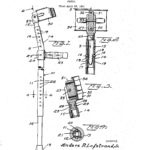
Plus tard, A. R. Lofstrand Jr. développe les béquilles avec réglage en hauteur, ce qui ancre le modèle moderne de la béquille d’avant-bras.
En Europe, ce type finit par devenir dominant.
Là encore, c’est un progrès réel, mais ce n’est pas une révolution comparable à ce qu’on a vu dans d’autres domaines techniques au XXe siècle. On perfectionne la géométrie, on rationalise la fabrication, on ajoute des réglages.
La béquille avance – mais à petits pas, presque vexants.
Il y a 50 ans : aluminium, plastique, standardisation de masse
Si on prend le repère “il y a 50 ans”, donc grosso modo les années 1970, le tableau est presque ironique :
le monde a déjà la télévision couleur,
l’informatique moderne est lancée,
l’aéronautique a changé d’échelle,
et la béquille, elle, ressemble encore furieusement à… une béquille.
Certes, on voit davantage d’aluminium, de poignées moulées, de manchettes en plastique, de séries industrielles mieux standardisées. Mais sur le fond, c’est toujours le même geste technique ancestral : un support vertical qui remplace une partie de la fonction de la jambe.
Aujourd’hui au XXIe siècle : un objet millénaire qui a très peu muté
Aujourd’hui, la béquille reste un objet millénaire qui a finalement peu muté sur le fond.
Les versions récentes à ressort, à restitution d’énergie ou à géométrie plus travaillée existent, mais elles demeurent encore marginales face au modèle classique.
Le constat historique est clair : on a énormément perfectionné la fabrication, mais très peu réinventé l’expérience réelle de marche avec béquilles.
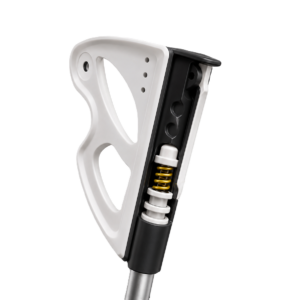
2011: La première canne ERGODYNAMIC avec système breveté d’absorption des chocs voit le jour
Amortisseur intégré
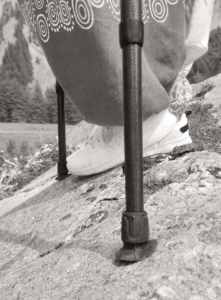
Embouts adaptables
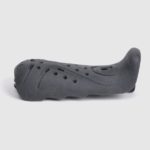
Poignée gel
Le constat historique est rude : on a consacré une créativité délirante à des technologies de confort, de loisir ou de distraction, alors qu’un outil aussi élémentaire que la béquille a longtemps été traité comme un simple bâton un peu mieux fini.
Références ↷
Hernigou P. Crutch art painting in the middle age as orthopaedic heritage. PMC, 2014.
Liu X et al. Incidence and dynamics of mobility device use among… PMC, 2024.
Schlick E. US1244249A – Walking-stick, brevet délivré en 1917.
Lofstrand A.R. Jr. US2711183A – Crutch.
US5458143A – Crutch with elbow and shank springs.
Dolhem R. La canne en T d’André Maginot. J Readapt Med. 1915;19(3):86–90. [Google Scholar]
Hernigou P. Ambroise Paré II: Paré’s contributions to amputation and ligature. Int Orthop. 2013;37(4):769–722. doi: 10.1007/s00264-013-1857-x. [DOI] [PMC free article] [PubMed] [Google Scholar]
Hernigou P. Ambroise Paré III: Paré’s contributions to surgical instruments and surgical instruments at the time of Ambroise Paré. Int Orthop. 2013;37(5):975–980. doi: 10.1007/s00264-013-1872-y. [DOI] [PMC free article] [PubMed] [Google Scholar]
Hernigou P. Ambroise Paré IV: the early history of artificial limbs (from robotic to prostheses) Int Orthop. 2013;37(6):1195–1197. doi: 10.1007/s00264-013-1884-7. [DOI] [PMC free article] [PubMed] [Google Scholar]
Le Vay D. The history of orthopaedics. Carnforth: The Parthenon Publishing Group; 1990. [Google Scholar]
Schlick E (1915) Canne-soutien à appui fixe ou flexible de l’avant-bras. Brevet d’invention no 479.036, demandé le 7 mai 1915, délivré le 13 novembre 1915. République française. Office national de la propriété industrielle. p 3
Tuffier T, Amar J. Cannes et béquilles en orthopédie dynamique (1915) Modèle scientifique d’une canne-soutien. Académie des Sciences, séance du 13 septembre 1915. Comptes rendus hebdomadaires des séances. Tome 161, juillet–décembre 1915, pp 302–304