
Design analysis
The crutch: not just support
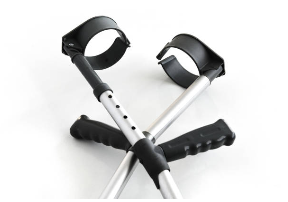
Walking aids rarely relieve one problem without shifting a constraint elsewhere.
Over time, crutches have taken load off the legs, often by transferring it to the upper body.
This page helps explain where the load shifts, what the body compensates for, and why some design changes truly matter.
The body accepts a lot. That does not always mean it agrees.
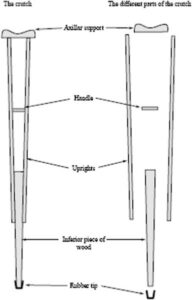
1. Axillary crutches (traditional)
- Design logic:
The axillary model transfers a significant part of the load from the lower limbs to the chest, armpits, and upper limbs. Its structure is simple, effective, and historically widespread. - What this means for the body:
When support is poorly distributed or prolonged, pressure in the axillary region can become problematic.
It may notably:
- Risk of “crutch palsy”: compress nerve structures, particularly at the level of the brachial plexus;
- Vascular impact: increase stress on vascular and soft tissues;
- Compensation: create areas of friction and discomfort in the thoracic and axillary region.
Main limitation
This model fulfills its offloading function, but it does so by stressing an anatomical area that is not really meant to bear this kind of support over time.
Put plainly:standing up, yes — but ideally not by crushing the nerve pathways in the process.
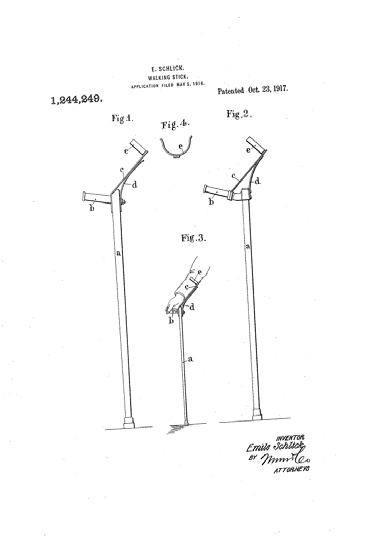
2. Forearm crutches (Canadian / Lofstrand)
- Design logic:
The forearm model removes axillary support and provides greater stabilization at arm level.
This was a real step forward in use. But it did not remove the constraint: it shifted it. - What this means for the body:
With this type of crutch, the load rests more heavily on the hands, wrists, elbows, and shoulders. In use, this can lead to:
- Joint overload, particularly at the wrists, elbows, and shoulders;
- Greater muscular demand, with more gripping, pushing, and control;
- Contact discomfort, linked to areas of friction or pressure on the forearm and hand.
Main limitation
The forearm model is often better tolerated than the axillary model, but it still places significant demands on the upper body..
Put simply: you gain more freedom of support, but not yet a biomechanical miracle.
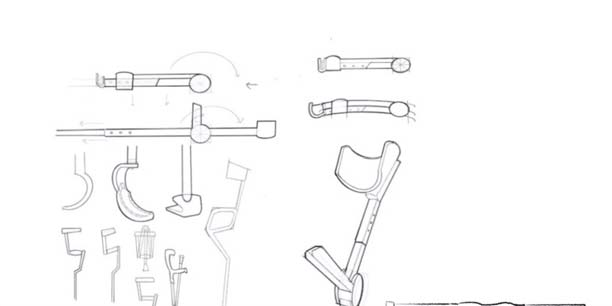
3. Medical canes and walkers
- Design logic:
The cane and the walker are designed to improve balance and increase stability when support or walking becomes uncertain. - What this means for the body:
These aids can improve safety during movement, but they also change posture and the way effort is distributed.
In use, this can lead to:
- postural compensation, with a tendency to lean or shift out of alignment in order to transfer the load;
- asymmetrical overload, especially with a single cane, when support becomes too one-sided;
- compensatory fatigue, when stability is achieved at the cost of prolonged effort from the trunk, shoulder, or upper limb.
Main limitation
These aids provide effective stabilization, but they do not by themselves correct the mechanical logic of movement.
Put plainly: they often make walking feel safer before they truly optimize it.
Summary table: Analysis of bodily impact
| Type of device | Main support point | Major risk | Long-term impact |
|---|---|---|---|
| Axillary | Armpits / Thorax | Nerve compression | Radial nerve palsy, axillary thrombosis |
| Forearm | Wrists / Palms | Joint stress | Carpal tunnel syndrome, shoulder tendinitis |
| Cane | Hand (unilateral) | Spinal imbalance | Lower back pain, poor posture |
conclusion
A crutch can fulfill its function without truly treating the body that uses it well.
The most relevant paths do not lie only in support, but in better transmitting, cushioning, and accompanying movement.
A coherent redesign should aim to:
- reduce the strain on the hands, wrists, and shoulders,
- cushion impact without stopping at a merely “soft” effect,
- return part of the movement so that walking feels less broken and less tiring,
- improve the overall acceptability of the technical aid in actual use.
The point is not to make the crutch more complicated.
It is to make it more biomechanically sound, more clinically tolerable, and more intelligent in what it asks the body to go through.
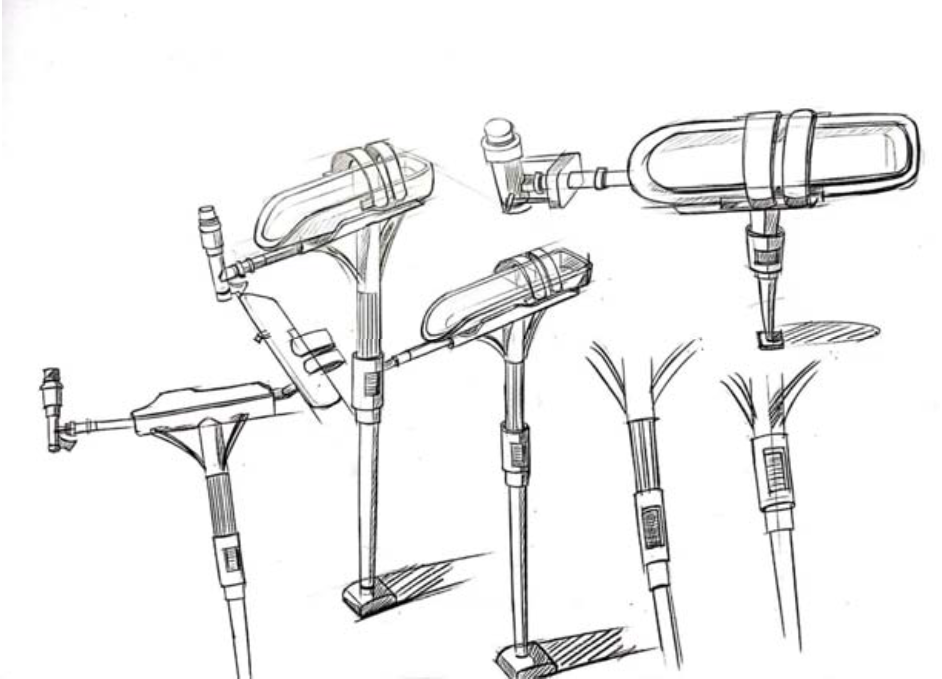
4. Innovation through materials: lighten, filter, distribute better
The choice of materials is not only about aesthetics or durability.
In a walking aid, it directly affects the weight to be moved, the quality of contact, the transmission of impact, and tolerability during prolonged use.
A. Lightweight alloys: reducing useful weight
Heavier materials, such as steel or certain standard aluminum alloys, offer robustness and ease of manufacture, but they also increase muscular effort with each support phase and each swing phase..
By contrast, lighter materials, such as certain magnesium alloys, reduce the effort needed to handle the crutch, especially with repeated or prolonged use.
The benefit is not only carrying less weight, but tiring the upper body less quickly.
B. Titanium and composite materials: managing strain better
Titanium and certain composite materials offer a good balance between strength, lightness, and mechanical behavior.
Their value does not lie only in their strength. Depending on the design chosen, they can also provide:
- less harsh contact,
- better distribution of strain,
- and a support feel that is more tolerable in use.
In other words, not all rigid materials are experienced by the body in the same way.
And fortunately, otherwise we would still be admiring a metal tube as the height of civilization.
C. Active systems: absorb, then return
When a spring system is integrated into the crutch, the point is not only to absorb part of the impact.
Otherwise, a softer tip would be enough to create the illusion for a few minutes.
The real benefit appears when this system also returns part of the movement:
- the support becomes less harsh,
- the transition smoother,
- the push-off less costly,
- and walking less broken.
A well-designed device does not merely cushion:
it also supports the dynamics of the step more effectively.
Summary of material advantages
| Material / Component | Physical property | Impact on the body |
|---|---|---|
| Magnesium | Low mass / structural lightness | Reduction of swing effort and upper-body fatigue |
| Titanium | Good strength-to-weight ratio, controlled elasticity | Potentially more tolerable support, with strain better filtered depending on the design |
| Rubber (tip) | Grip / local impact filtering | Better contact stability and reduced harshness of support |
| Spring system | Absorption + partial energy return | Less broken support, smoother push-off, reduced perceived effort |
What this changes in actual use
A walking aid is not judged only by its ability to support.
It is also judged by the way it is experienced day to day: effort, freedom of movement, mental load, and real-world acceptance.
When support becomes smoother, more stable, and less tiring, use changes in concrete ways:
- less functional dependence, because certain everyday actions become simpler again;
- less mental load, because each step requires less correction, less vigilance, and less compensation;
- more room for life, because a better-designed aid does not merely keep you upright: it makes movement more bearable over time.
In summary:
A well-designed crutch does not only change walking.
It also changes the way we endure it.
References ↷
- Shang Erling, Multifunctional Crutch, Politecnico di Torino, Laurea Magistrale in Design Sistemico, 2020/2021.
https://share.google/AXMrdC61dSRibslF7 - 1. Impacts des Béquilles Axillaires (Neurologie)
– Raikin S. & Froimson M.I. (1997). Bilateral brachial plexus compressive neuropathy (crutch palsy). Journal of Orthopaedic Trauma.
– Malkan D. (1992). Bilateral ulnar neuropraxia: a complication of elbow crutches.
– Journal of Bone and Joint Surgery (1964). Axillary artery thrombosis after prolonged use of crutches. - 2. Béquilles d’Avant-bras et Surcharge Articulaire
– Shortell D., et al. (2001). The design of a compliant composite crutch. Journal of Rehabilitation Research and Development.
– Opila et al. (1987). Upper-limb joint degeneration in crutch users. - 3. Déséquilibre Postural et Biomécanique
– Shoup T.E., et al. (1974). Biomechanics of Crutch Locomotion. Journal of Biomechanics.
– Bateni H. & Maki B.E. (2005). Assistive devices for balance and mobility: benefits, demands, and adverse consequences. - 4. Matériaux et Systèmes Actifs (Amortissement)
– Segura A. & Piazza S.J. (2007). Mechanics of ambulation with standard and spring-loaded crutches. Archives of Physical Medicine and Rehabilitation.
– Zhang Y., et al. (2013). Biomechanical evaluation of an innovative spring-loaded axillary crutch design. - 5. Impact Psychologique et Autonomie
– Jaspers et al. (1997). Psychological and physiological importance of standing and walking on their own.
– Study on stigma and user comfort (2022). Reimagining crutches: examining stigma and user comfort.